From Adegem to Missouri
The Flemish roots and American life of Jacobus Michiels, later known as James Michiels or James Michaels
Adegem
Zomergem
Flanders
Perry County, Missouri
1818 migration
800 years of family history

The Flemish roots and American life of Jacobus Michiels, later known as James Michiels or James Michaels
The story of Jacobus Michiels, later known in America as James Michiels or James Michaels, begins deep in the rural landscape of the Meetjesland in Flanders. Long before one branch of this family crossed the Atlantic, the name already appeared in the parish registers of Adegem in a variety of spellings: Machiels, Michiels, Michiel and Mechiels. In the early eighteenth century, Jacob Machiels, probably born around 1718, married Judoca Vincke, who had been born in Oostwinkel in 1721. Together they settled in Adegem, where they raised a large Catholic family and became part of the close-knit village world that shaped so many Flemish lives.
The baptisms of their children still survive in the parish records and offer a fine glimpse into that world. Their first known child, Maria Cornelia Machiels, was baptized in Adegem on 9 April 1745, with Jan Baptist de Keijser and Maria de Meijere acting as godparents. A year later, on 1 October 1746, Maria Jacoba Machiels was baptized, with Frans Keppens and Joanna Cornelia Eeckhaut standing beside the font.
On 18 September 1748, a son, Jan Corneel Machiels, was baptized, with Jan Dhooghe and Barbara de Brabander as godparents. Two years later, on 18 November 1750, Maria Anna Elisabeth Machiels followed, her baptism witnessed by Peter de Bruijckere and Maria Anna de Zuttere. On 18 May 1753 another son was baptized and again named Jan Corneel Machiels, a familiar custom in an age when the earlier child of the same name had likely died young. His sponsors were Corneel Vincke and Isabella Francisca De Pauw.
The family continued to grow with Petronilla Machiels, baptized on 13 February 1755 with Jan Baptist Buijsse and Petronella Remerij as godparents; Pieter Machiels, baptized on 19 January 1757 with Frans Jan Klincke and Anna Maria Vincke; and Joanna Livina Machiels, baptized on 21 August 1759 with Livien De Pauw and Joanna Theresia Vander Meulen standing as witnesses.
These names are more than dry entries in a register. They reveal the social and family network in which the Machiels family lived. The repeated appearance of surnames such as Vincke, De Pauw, Buijsse, Dhooghe, De Zuttere and Keppens shows how village life in eighteenth-century Adegem was woven together through kinship, friendship, work, religion and neighborhood ties. It is from this Flemish setting that the later American branch emerged.
One descendant of this Adegem family appears to have been the later Jacobus Michiels who would leave for America in 1818. The most promising lead points to a marriage in February 1780 between Johannes Michiels of Adegem and Maria Jacoba De Keyser of Zomergem. Their household forms a plausible bridge between the older Adegem generations and the young man who would later declare in Missouri that he had been born in the parish of Zomergem.
A baptism entered at Zomergem on 30 March 1794 for Jacobus Michiels fits the approximate age and place later given in his American naturalization papers. Although this identification is highly suggestive, the final piece of documentary proof is still missing. No surviving letter, will, inheritance reference or other contemporary record has yet been found that explicitly states that the Jacobus baptized in Zomergem is the same man who later appeared in Perry County, Missouri.
From his naturalization papers we learn that Jacobus Michiels stated that he was born in the parish of Zomergem, on the River Schelde, in the Kingdom of Holland. He declared that he had emigrated on 13 April 1818 directly from Flanders and arrived on 20 August 1818 in Annapolis, Maryland. Unfortunately, he did not name the ship that carried him across the ocean. The voyage, lasting roughly four months, strongly suggests that the ship made several stops before reaching North America. It also raises an intriguing question: was he a paying passenger, or did he perhaps work his passage aboard ship?
On 17 March 1823, in the Perry County Circuit Court in Missouri, Jacobus made his formal declaration of intention to become a citizen of the United States. In that document he renounced his allegiance to any foreign sovereignty, particularly the Crown of Holland, and stated that he was twenty-seven years old. He also declared his intention to settle in the State of Missouri. Why he chose Missouri remains one of the unanswered questions in his life story.
One possible explanation lies in the religious migration networks of the period. Several Catholic priests from Belgium served communities in Missouri and Kentucky, and reports of fertile land and opportunities in America undoubtedly traveled back across the Atlantic. Among the best-known missionaries was Rev. Charles Nerinckx. It is possible that such channels of information influenced Jacobus or his circle, even though no direct evidence has yet been found. Equally uncertain is whether he crossed the ocean alone or in the company of a friend, a relative or a larger migrant group.
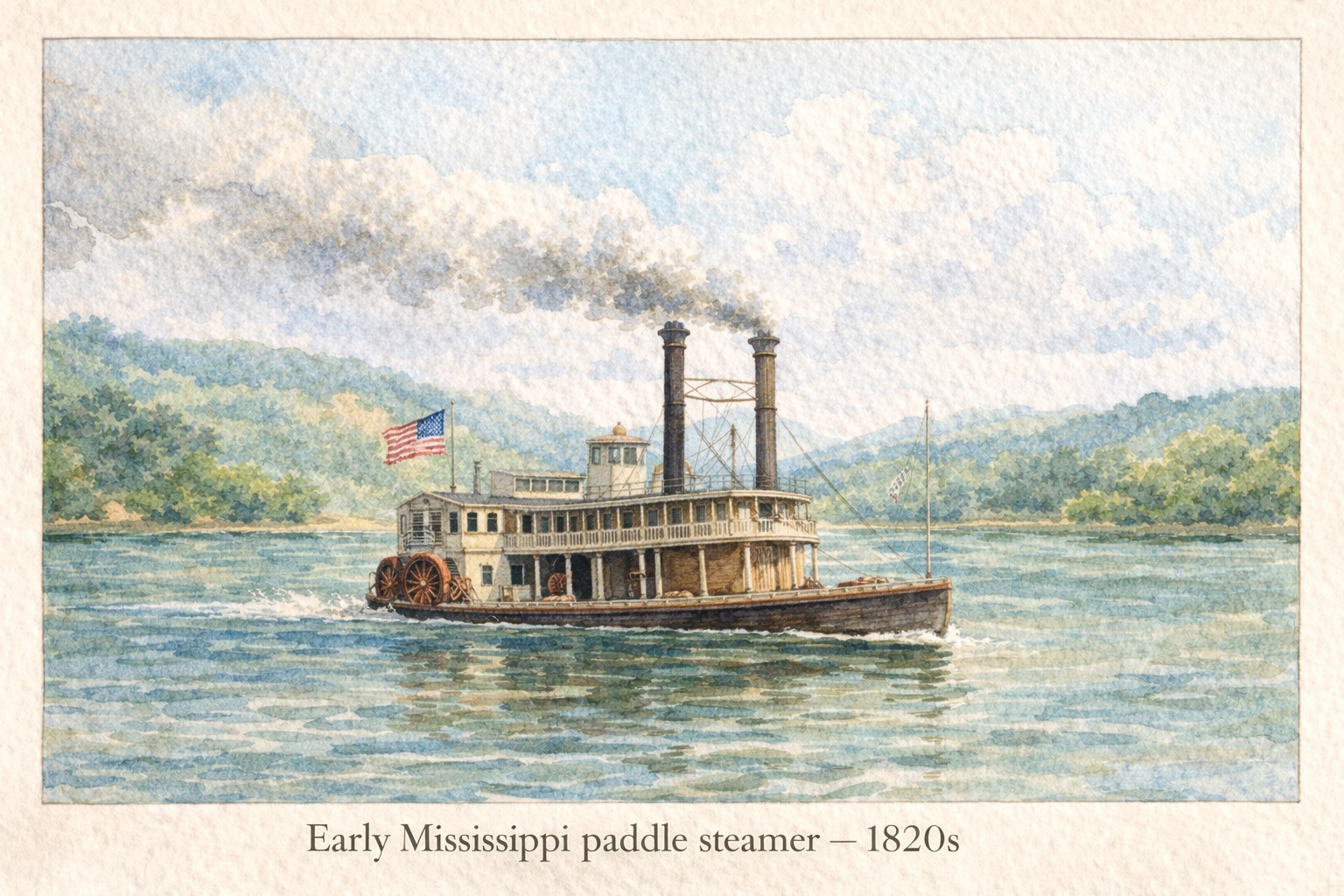
Early Mississippi paddle steamer, typical of the vessels that travelled the Ohio and Mississippi rivers in the early nineteenth century. Immigrants moving west toward Missouri often continued their journey by riverboat after reaching the Ohio River.
Although no document has yet been found that describes the inland route taken by Jacobus Michiels after his arrival in Annapolis, the journeys made by other migrants and missionaries in the same period make it possible to imagine the kind of road he may have followed. For a newly arrived immigrant in 1818, landing on the Atlantic coast was only the beginning. The real challenge often started after setting foot in America, when the traveler still had to cross mountains, rivers and frontier settlements before reaching the Mississippi Valley.
After arriving in Maryland, a traveler heading west usually first gathered provisions, secured space on a wagon, and joined others moving inland by road. The first stage led through the settled landscapes of Maryland and Pennsylvania, but before long the route climbed toward the rugged barrier of the Allegheny Mountains. Roads were rough, weather could be difficult, and progress was slow. Horses strained, wagons creaked, and each mile westward demanded patience and endurance.
One of the key gateways to the interior was Wheeling on the Ohio River. There the overland journey often gave way to river travel. Flatboats, broad and practical rather than elegant, carried passengers, food, tools, baggage and sometimes even wagons down the Ohio River. The current itself became the engine of movement, drawing travelers deeper into the heart of the continent.
Further downstream lay Louisville, where the Falls of the Ohio formed a well-known obstacle. Boats had to be carefully guided through dangerous waters, or goods and passengers were carried around the rapids before the journey could continue. Beyond that point the river route opened toward the great western basin. From there, travelers moved onward toward the Mississippi Valley and eventually to St. Louis, already one of the major gateways to the western frontier.
For a man like Jacobus Michiels, such a route would have been long and uncertain, yet entirely plausible. From St. Louis the final stage into southeastern Missouri would have been far shorter, following the river settlements toward Perry County. Whether he made that journey alone or in company with others, the route from Annapolis to Missouri must have impressed itself deeply upon him: the seacoast left behind, the mountains crossed, the Ohio descended, and at last the Mississippi frontier reached.
Illustrative route followed by many migrants and missionaries: Annapolis → Baltimore → Wheeling → Ohio River → Louisville → Mississippi → St. Louis → Perry County.
From his naturalization papers we learn that Jacobus Michiels stated that he was born in the parish of Zomergem, on the River Schelde, in the Kingdom of Holland. He declared that he had emigrated on 13 April 1818 directly from Flanders and arrived on 20 August 1818 in Annapolis, Maryland. Unfortunately, he did not name the ship that carried him across the ocean. The voyage, lasting roughly four months, strongly suggests that the ship made several stops before reaching North America. It also raises an intriguing question: was he a paying passenger, or did he perhaps work his passage aboard ship?
On 17 March 1823, in the Perry County Circuit Court in Missouri, Jacobus made his formal declaration of intention to become a citizen of the United States. In that document he renounced his allegiance to any foreign sovereignty, particularly the Crown of Holland, and stated that he was twenty-seven years old. He also declared his intention to settle in the State of Missouri. Why he chose Missouri remains one of the unanswered questions in his life story.
One possible explanation lies in the religious migration networks of the period. Several Catholic priests from Belgium served communities in Missouri and Kentucky, and reports of fertile land and opportunities in America undoubtedly traveled back across the Atlantic. Among the best-known missionaries was Rev. Charles Nerinckx. It is possible that such channels of information influenced Jacobus or his circle, even though no direct evidence has yet been found. Equally uncertain is whether he crossed the ocean alone or in the company of a friend, a relative or a larger migrant group.
The region where James Michiels settled lay in the southeastern part of Missouri along the Mississippi River, about ninety miles south of St. Louis. It was first known as Bois Brulé and was later sometimes referred to as Belgique, a name reflecting the Belgian background of some of its settlers. At the time of his arrival the area still carried traces of its earlier French and colonial identity, for it had once formed part of the Upper Louisiana Territory and was historically linked to Sainte Genevieve.
From 1801 onward Catholic settlers from Kentucky began moving into this district, attracted by rich farmland and government land grants. Many of these Kentucky Catholics had themselves descended from families that had come earlier from Maryland. In 1821, when Missouri gained statehood, Perry County was formally created from the southern part of Sainte Genevieve. James Michiels thus arrived in a young and changing frontier society, but one with a distinctly Catholic character that may well have appealed to a migrant from Flanders.
By 1820 James had married Susanna Layton, daughter of John Layton, a man who would later play a role in early Missouri politics. James and Susanna appear in the first parish census of St. Mary of the Barrens Congregation in Perry County in 1823, one of the earliest Catholic church communities in the region. Their inclusion there places them firmly within the first generation of Catholic settlers in that district.
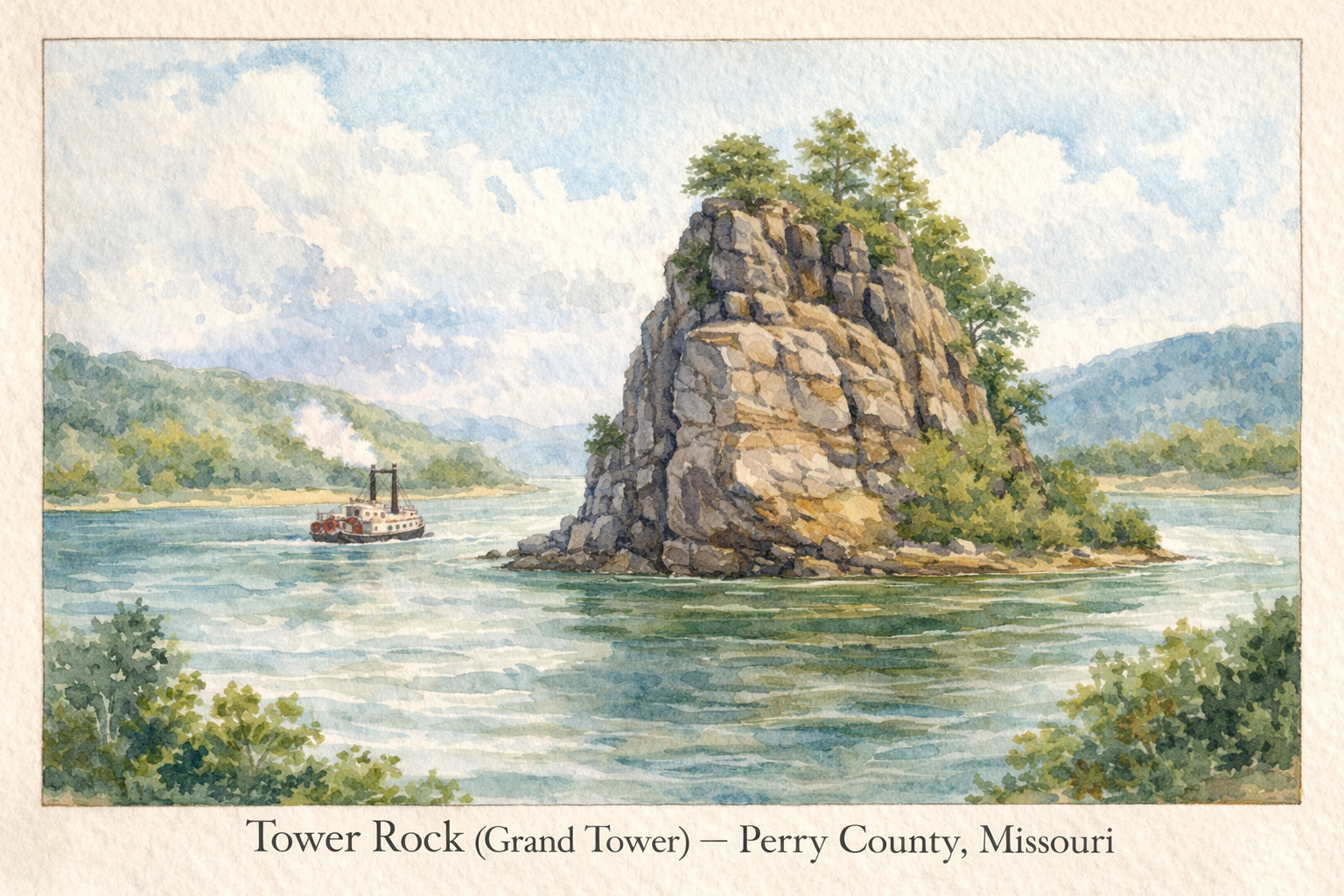
Tower Rock (Grand Tower) in the Mississippi River, Perry County, Missouri. This striking rock formation was listed on the National Register of Historic Places in 1970.
Unlike many settlers in Perry County, James Michiels does not appear to have made his living primarily as a farmer. Instead, the surviving deeds and court records suggest a man active in local trade and hospitality. He seems to have operated an inn or tavern, and he must have been an amiable host, for he was once indicted for suffering a card table in his establishment and a second time for selling liquor without a license, for which he was fined.
Other records indicate that he also acted as a shopkeeper. He sold goods on credit to neighbors and residents in the area, ranging from candy to blacksmithing tools. These small details bring him vividly to life. He appears not only as an immigrant and settler, but as a man woven into the economic and social life of an emerging Missouri community.
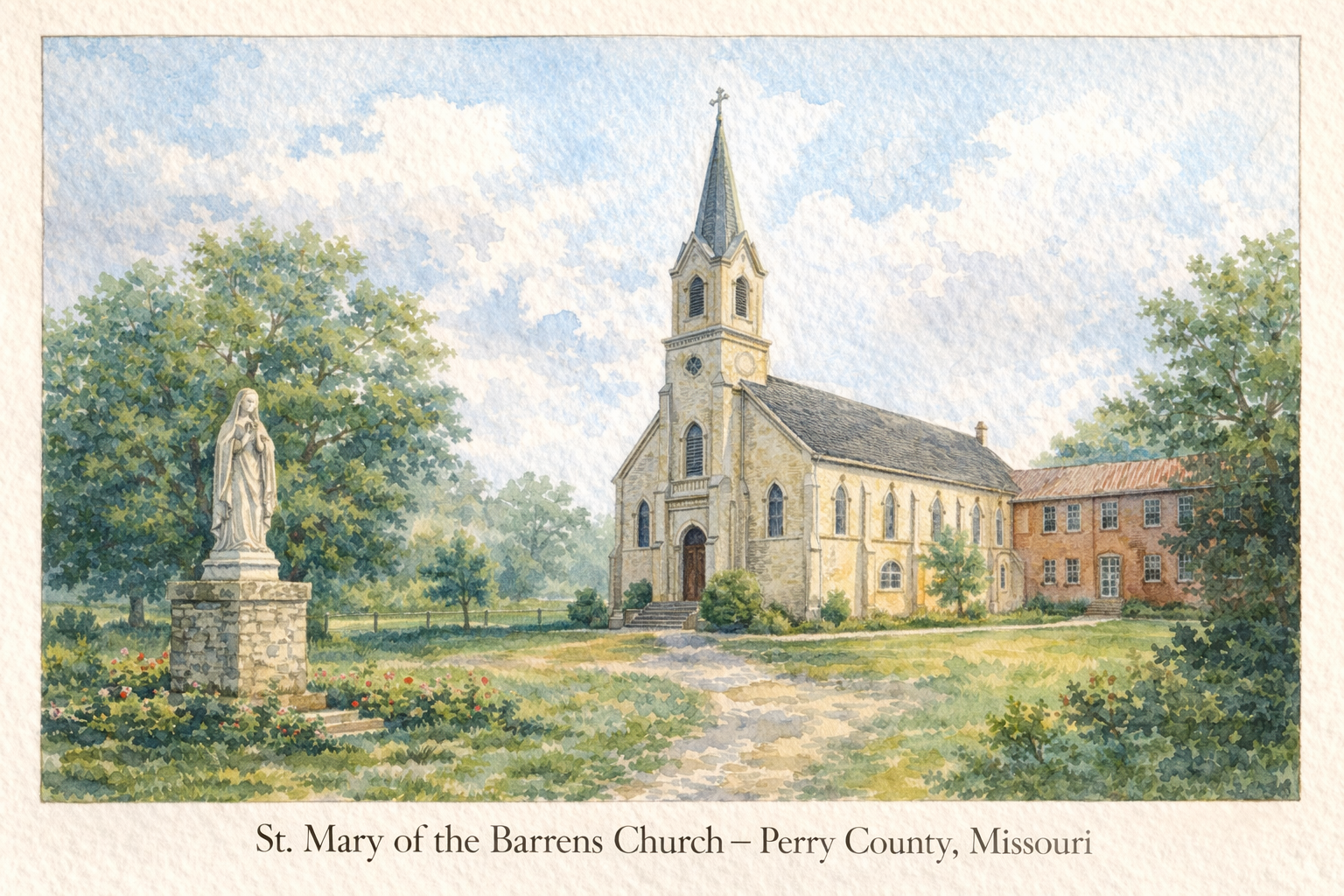
St. Mary of the Barrens Church, Perry County, Missouri. One of the earliest Catholic parishes in the region, where the family of James (Jacobus) Michiels appears in the parish census of 1823.
James and Susanna Michiels built a large family in Perry County. They became the parents of ten children, eight of whom survived to adulthood. All of the children were baptized in the Catholic Church, preserving in America the same religious continuity that had marked the family in Flanders. Their household appears in the 1830 and 1850 United States Federal Censuses, which confirm the family’s continuing place in the county over several decades.
James Michiels died in Perry County on 2 December 1857 and was buried in the church cemetery. Funeral records note that he was sixty-four years old at the time of his death. Missouri did not yet require civil death certificates in that period, but fortunately the Catholic church preserved the record of his burial, allowing his life to remain at least partly visible to later generations.
For a long time the exact identity of the parents of Jacobus Michiels remained uncertain. The hypothesis linking him to Johannes Michiels of Adegem and Maria Jacoba De Keyser of Zomergem appeared very convincing, but definitive proof had long been missing. Genealogical research often advances slowly, and for years this connection remained an open question.
This situation changed in 2019 when Donna Miles Wood from Texas contacted the author for assistance with research in Belgium. Donna, herself a descendant of Jacobus Michiels, was searching for the Flemish origins of her family. By combining American records with the parish registers of Adegem and Zomergem, and by examining the composition of the Michiels family described earlier in this article, the missing connection could finally be clarified.
Through this collaboration it became clear that the Jacobus Michiels who emigrated in 1818 fits perfectly within the family structure reconstructed from the Flemish parish records. What had long appeared to be an unresolved genealogical puzzle could therefore be placed with much greater certainty within the Michiels family of the Meetjesland region.
The exchange of information worked both ways. While the Belgian research helped Donna better understand the origins of her ancestor, she in turn revealed an extraordinary piece of family history: that Jacobus Michiels had left the Meetjesland as early as 1818 to build a new life in the United States. Without her contact and research, this remarkably early emigrant from the region might easily have remained unknown.
This cooperation illustrates how modern genealogy often bridges continents. By connecting research carried out in local Belgian archives with family traditions and documents preserved in the United States, a story that had been separated for two centuries could finally be brought together again.
The departure of Jacobus Michiels in 1818 is particularly remarkable when viewed in the broader context of Belgian migration history. Large-scale emigration from Flanders to the United States did not begin until several decades later, especially after the agricultural crises of the 1840s. The majority of migrants from the Meetjesland and neighbouring regions left between about 1845 and 1860.
Jacobus Michiels therefore belongs to a much earlier generation of pioneers who crossed the Atlantic long before organized migration streams existed. At that time journeys were uncertain, expensive and often dangerous, and information about opportunities in America was limited. His decision to leave Flanders in 1818 and travel to the frontier settlements of Missouri places him among the earliest known emigrants from the Meetjesland region to the American Midwest.
Seen from this perspective, the story of Jacobus Michiels is not only a family history but also part of a larger narrative of early transatlantic migration. Long before the great waves of nineteenth-century emigration, individuals such as him were already building connections between the rural parishes of Flanders and the developing frontier communities along the Mississippi River.
The migration of Jacobus Michiels also fits within a broader movement of Catholic settlers who gradually moved westward across the young United States during the late eighteenth and early nineteenth centuries. Many of these settlers originally lived in Maryland, one of the earliest centers of Catholic life in North America. From there families began moving westward into Kentucky during the late 1700s, seeking farmland and religious freedom.
In the early nineteenth century this migration continued further west toward the Mississippi Valley. Catholic missionaries and priests played an important role in this movement. They encouraged settlement in regions where new Catholic communities could be established and maintained. Letters sent back to Europe often described the fertile lands of the Mississippi region and the opportunities available there.
When Missouri became a state in 1821, areas such as Ste. Genevieve, Florissant and the settlements of Perry County quickly developed into important centers of Catholic life in the American frontier. Missionaries arriving from Europe — including those associated with the work of Rev. Charles Nerinckx — followed similar travel routes from the Atlantic coast to the Mississippi Valley only a few years after Jacobus Michiels had made his journey.
Seen within this wider context, the journey of Jacobus Michiels in 1818 becomes even more significant. He appears not only as an early emigrant from the Meetjesland region of Flanders, but also as part of the broader Catholic movement that helped establish new communities along the Mississippi frontier during the early decades of the nineteenth century.
Maes, Camillus P. The Life of Rev. Charles Nerinckx . Cincinnati: Robert Clarke & Co., 1880.
See especially the description of the missionary journey from Maryland to Missouri: pp. 466–467 .